Each nutrient that runs short leaves its own pattern on cannabis leaves. The same pattern, though, often comes from a root-zone pH problem rather than a real shortage. This guide describes the signs of each deficiency from nitrogen to boron, with the usual causes and fixes. It ends with a reference table.
Two rules apply to every section below. The first is position. Mobile nutrients (nitrogen, phosphorus, potassium, magnesium) show first on old, lower leaves, because the plant moves them out of old leaves to feed new ones. Immobile nutrients (calcium, iron, manganese, zinc, boron, and in practice sulfur) stay where they were laid down, so they show first on new growth at the top.
The second rule is to check before you feed. Measure the root-zone pH and the runoff EC, and look at the roots, before you add any product. Runoff is the water that drains from the pot after watering. EC (electrical conductivity) is its dissolved salt level, measured in mS/cm.
This is Part 2. Part 1: Nutrient Problems on Cannabis Leaves: Check pH, Runoff EC and Roots Before You Feed (Part 1 of 2)
1. Nitrogen (N): Mobile
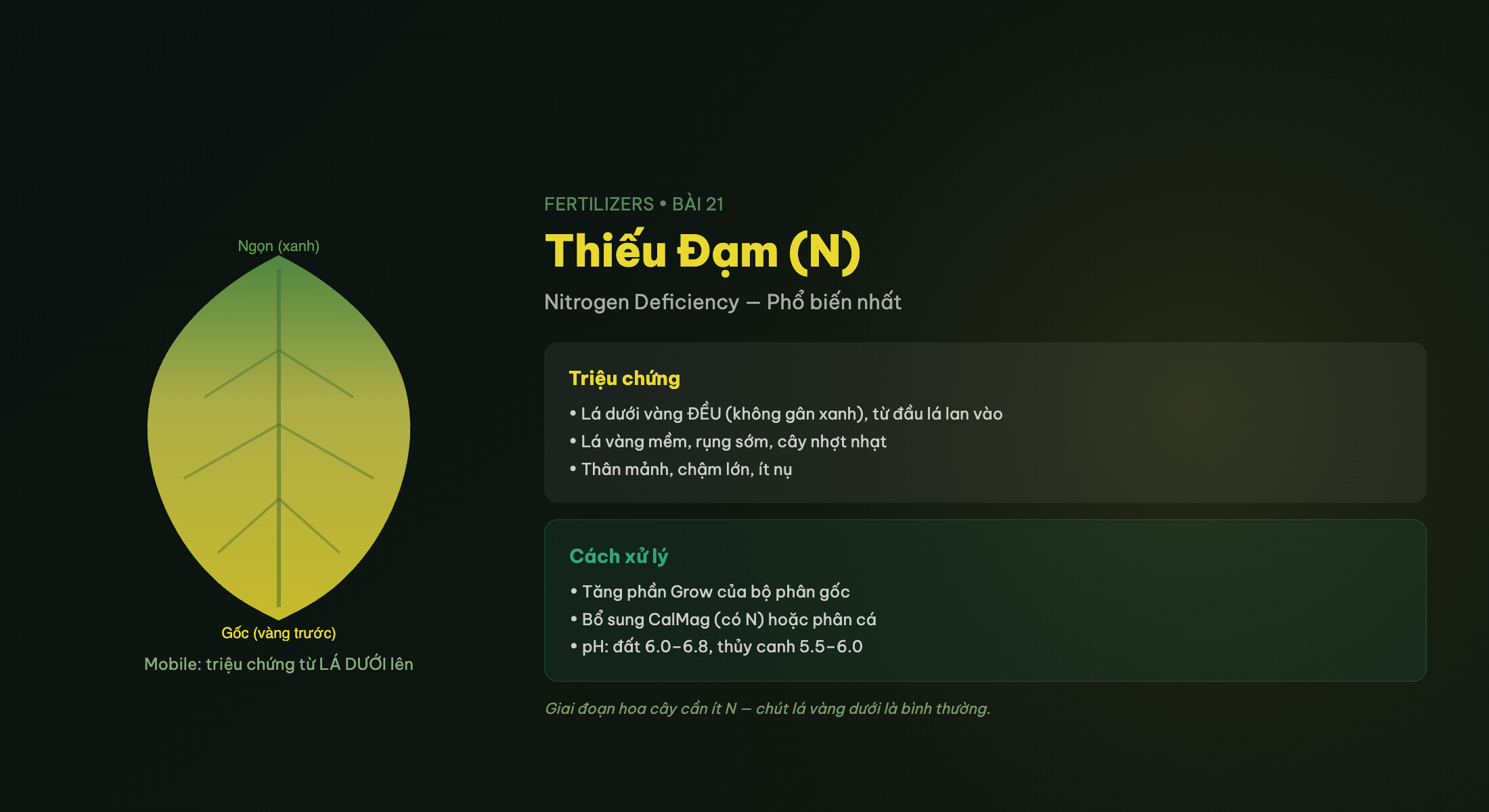
Nitrogen deficiency is the most common nutrient problem in cannabis. It is most common in the vegetative stage, when the plant needs a lot of nitrogen to build leaves and stems.
Symptoms
- Lower leaves turn evenly pale, then yellow across the whole blade, with no green veins left. They then turn light brown and drop.
- The yellowing climbs steadily up the plant from the bottom.
- The plant looks washed out. Stems are thin, growth slows, and fewer bud sites form.
The yellowing is even across the leaf, with no green-vein pattern. That is what separates nitrogen deficiency from magnesium or iron deficiency.
Common causes
- Too little nitrogen in the feed. In organic soil this often happens late in the mix’s life, once the nutrients mixed into it are used up.
- pH out of range. Roots take up nitrogen as nitrate or ammonium, and both are sensitive to pH.
- Roots damaged by overwatering or by compacted soil.
- Too much flushing.
Fix
- Check the pH first.
- Raise the “grow” (vegetative) part of your base nutrients.
- For a quick nitrogen source, use a CalMag product that contains calcium nitrate. In organic systems, use fish emulsion, a liquid fertiliser made from fish.
In late flower, some yellowing of the lower leaves is normal. The plant moves nitrogen out of old leaves as it matures. Do not correct it.
What to do: if yellowing climbs from the bottom during the vegetative stage, check the pH first. Then raise the grow nutrients a little and watch the next new leaves for 5–7 days. In late flower, write it down as normal ageing and leave it.
2. Phosphorus (P): Mobile
Phosphorus moves energy around the plant and drives root growth and flower formation.
Symptoms
- Older leaves first turn unusually dark green or blue-green rather than yellow.
- Purple, red or maroon colour develops on the petioles (leaf stalks), the stems and the undersides of leaves. This comes from a build-up of anthocyanin, a natural purple pigment.
- In advanced stages, dark spots of dead tissue (necrosis) appear on old leaves, and leaves may curl down.
- Growth is slow, roots are weak, flowering is delayed, and flowers are small with little resin.
Common causes
- pH below 5.5 or above 7.0. At these extremes, phosphorus binds with calcium, iron or aluminium into solid compounds that roots cannot take up.
- A root zone colder than about 15 °C, because phosphorus uptake depends strongly on temperature.
- Too much iron or zinc, which compete with phosphorus for uptake.
Fix: correct the pH, then raise the bloom nutrients or add a PK product, a fertiliser high in phosphorus and potassium. Organic sources are bone meal, bat guano and rock phosphate.
Purple colour alone does not prove a phosphorus shortage. Many cultivars produce anthocyanin because of their genetics, especially when nights are cool. Suspect phosphorus only if the purple petioles come with stunted growth and your pH and EC are otherwise in order.
Translator’s note: in most lowland growing in Thailand, a root zone below 15 °C is unlikely. Highland sites in the north during the cool season may be the exception. If you grow there, measure the temperature of the medium at dawn with a thermometer. You will then know whether cold is a possible cause.
What to do: before you blame phosphorus for purple stems, check whether growth is also stunted and whether pH and EC are in range. If growth is normal, record the colour as a cultivar trait and do not add phosphorus.
3. Potassium (K): Mobile
Potassium controls water pressure inside cells. It also controls the stomata (the leaf pores that open and close to let gas and water in and out) and moves sugars around the plant.
Symptoms
- The edges and tips of older leaves turn yellow, then brown and scorched. The centre of the leaf stays green for a while.
- Leaves become dry and brittle, and rust-coloured spots may appear on the blade.
- Leaf edges may curl up before the tissue dies. Plants also resist pests and disease less well.
Common causes
- pH below 5.5 or above 7.0.
- A feed high in ammonium. Ammonium competes with potassium for the same uptake channels in the root.
- Sodium in the water. Sodium pushes potassium off the sites on soil or coco particles that hold nutrients for the roots.
Fix: correct the pH, then raise the bloom/PK feeding. Another option is potassium silicate, which also strengthens stems. Organic options are kelp meal (dried seaweed) or wood ash. Wood ash raises pH, so use it carefully.
Burnt tips in late flower are often normal ageing combined with the plant’s high potassium demand at that stage. They are not a deficiency to correct.
Translator’s note: if you water from a well, ask the laboratory for a sodium figure when you have the water tested. A known sodium level tells you whether your water could be causing potassium problems.
What to do: when older leaves scorch at the edges, check the pH and runoff EC first. In late flower, do not chase burnt tips with more potassium.
4. Calcium and Magnesium (CalMag)
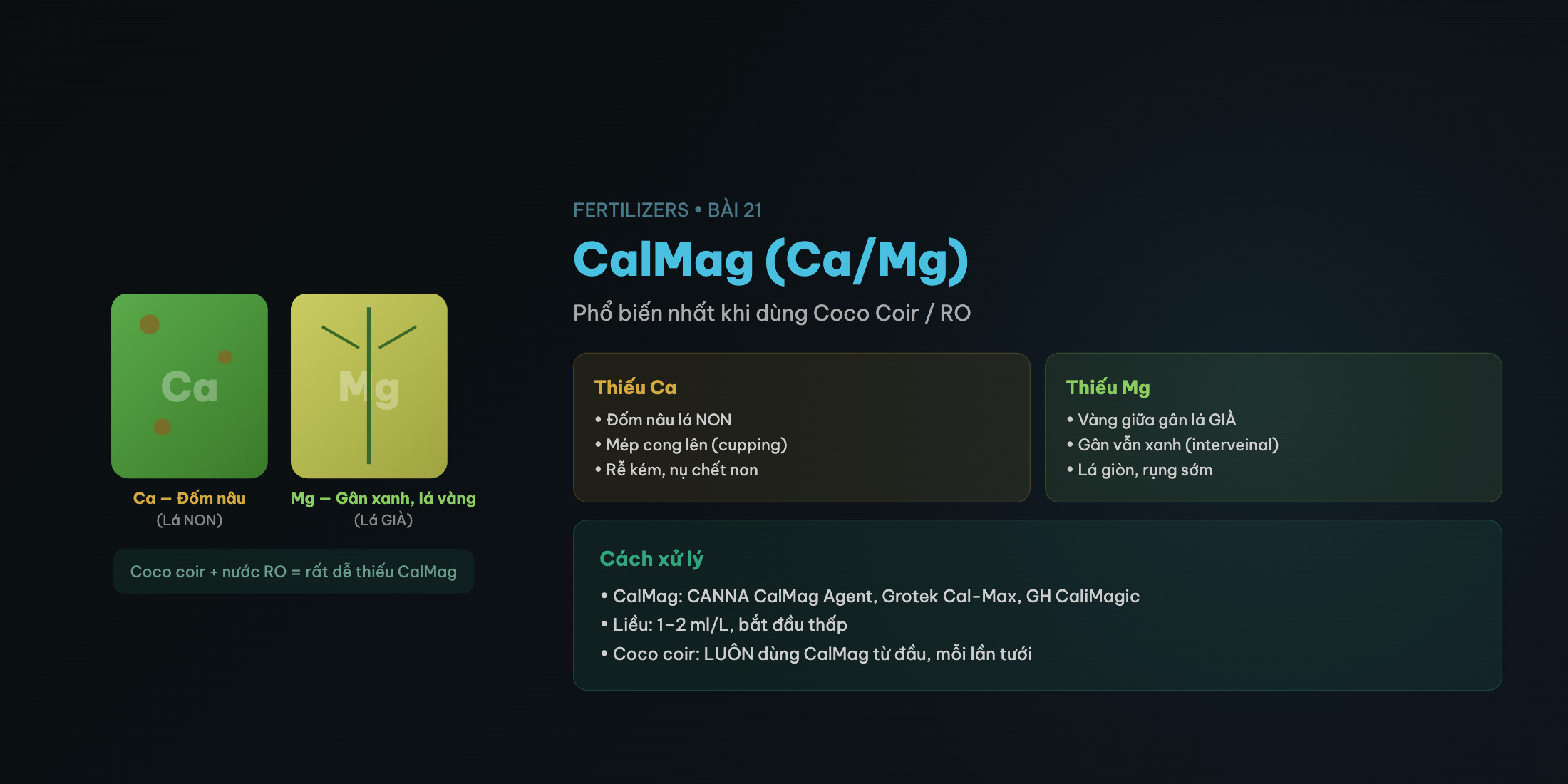
Calcium and magnesium deficiencies are very common in coco coir. They are also common when you water with RO water or other filtered water. RO (reverse osmosis) water has had almost all of its minerals removed.
Calcium (Ca): immobile
Symptoms: brown or tan spots on new leaves, sometimes called leopard spotting. New leaves cup, twist or fail to unfold properly. Root tips are weak, and in flower, buds may abort.
Common causes
- pH below 5.5.
- Unbuffered coco, which means coco that has not been pre-treated. It strips calcium out of the root zone.
- A feed with too much magnesium compared with calcium. The two compete for uptake.
- Low transpiration. Transpiration is water evaporating from the leaves, which pulls water and dissolved calcium up from the roots.
Calcium travels only in this transpiration stream. Very high humidity, low VPD or poor airflow can therefore starve the growing tips even when the root zone has enough calcium. VPD (vapour pressure deficit) measures how strongly the air draws water out of leaves. When VPD is low, the air is so moist that leaves barely transpire.
Under strong light and heat, growth can outrun the calcium supply and the tips burn. Fix this by improving VPD and airflow, not by adding calcium.
Translator’s note: in the Thai rainy season, humidity in grow rooms and greenhouses stays high for weeks. It rises further if fans stop during a power cut. Check a hygrometer (humidity meter) before you add calcium. Improve airflow and dehumidification first. Outdoors you cannot lower the humidity, so space plants far enough apart for air to move between them.
Magnesium (Mg): mobile
Symptoms: interveinal chlorosis on older leaves. The tissue between the veins turns yellow while the veins stay clearly green, in a sharp fishbone pattern. Later the yellow areas turn tan with spots of dead tissue. The leaves then become brittle, curl and drop. The damage moves from the bottom of the plant upward.
Common causes
- pH below 6.0 in soil or below 5.5 in coco. This is the most frequent cause.
- Heavy potassium feeding, because potassium and magnesium compete.
- RO water or very soft water used without CalMag.
- Frequent watering of coco with too little magnesium in the feed.
Fix
- Add a CalMag supplement at the label rate. Start low and increase gradually.
- In coco, and when using RO water, most growers include CalMag from the first feed.
- Check the calcium-to-magnesium balance of your base nutrient, and check the humidity and airflow in the room.
Translator’s note: collected rainwater is also very low in minerals. Measure its EC. If the reading is near zero, treat it like RO water and add CalMag.
Translator’s note: CalMag products and chelated iron (see Section 5) are made by many fertiliser brands. Ask the official Thai distributor of your nutrient brand which of them are imported and registered for sale in Thailand. The Fertilizer Act B.E. 2518 was amended by the Fertilizer Act (No. 2) B.E. 2550. Topic 1464 explains how to check that a fertiliser is sold legally in Thailand.
What to do: if you grow in coco or water with RO water or rainwater, start CalMag at a low label rate from the first feed. If only the tips of new leaves burn under strong light, check humidity and airflow before you add more calcium.
5. Micronutrients and Sulfur: Iron, Zinc, Manganese and Boron
Micronutrients are needed only in tiny amounts, but a shortage still does real damage. All of the nutrients in this section show their symptoms on new growth.
Iron (Fe). The newest leaves turn yellow between the veins while the veins stay green. In severe cases, new leaves turn almost white. A single affected leaf looks identical to one with magnesium deficiency, so position on the plant tells the two apart. Iron shows at the top and magnesium at the bottom.
Causes of iron deficiency:
- root-zone pH above about 6.5;
- water rich in bicarbonate, which slowly raises the pH;
- high phosphorus, which forms iron phosphate that roots cannot take up;
- waterlogged roots.
Zinc (Zn). New leaves are small, narrow, wavy or wrinkled. The internodes (stem sections between leaf joints) are unusually short, so the plant looks stunted and compressed. Some yellowing between the veins appears on new growth. Causes: pH above 6.5–7.0, or too much phosphorus.
Manganese (Mn). Yellowing between the veins, with small tan or brown spots, appears on young to middle-aged leaves. It is easily confused with magnesium deficiency, but it shows on newer tissue. It is fairly uncommon when plants get commercial fertilisers. Causes: pH above 6.5, or too much iron.
Boron (B). Growing tips become deformed. New leaves are thick and brittle and do not open, and the tips die back. Stems may turn hollow or corky. Boron deficiency is one of the easiest to recognise, because it changes the shape of the plant rather than its colour. Causes: pH outside 6.0–7.0, or uneven watering, because boron moves with the transpiration stream.
Sulfur (S). New growth turns evenly pale yellow-green, without the between-the-veins pattern of iron or magnesium. This is uncommon with mineral fertilisers, because their sulfate salts supply sulfur along the way. It is seen mostly in organic systems that rely on slow mineralisation, where soil life slowly breaks organic matter down into nutrients roots can take up. It is also seen in cool soil, or where the compost is not yet mature.
Fix: check the pH first. Most micronutrient symptoms come from pH lockout, not from a true absence of the nutrient. If the pH is right and the symptoms persist, add a supplement at a low rate. For iron, use chelated iron, which is iron bound to a molecule that keeps it dissolved. The EDDHA-Fe form holds up best at higher pH. For zinc, use zinc sulfate.
Translator’s note: some well and mains water in Thailand is hard, meaning it is rich in dissolved minerals such as bicarbonate. Water like this pushes the root-zone pH up slowly, week by week, so iron problems appear gradually. Measure the runoff pH every week, so you catch the rise before the new leaves turn pale.
What to do: when new leaves yellow between the veins, measure the runoff pH before buying any micronutrient. Add chelated iron at a low rate only if the pH is in range. Then judge the result by the leaves that grow afterwards.
6. Deficiency Reference Table
| Nutrient | Mobile? | Main symptom | Appears first on | Most common cause |
|---|---|---|---|---|
| Nitrogen (N) | Yes | Even yellowing, from the bottom up | Oldest leaves | Too little N; pH out of range |
| Phosphorus (P) | Yes | Dark green, then purple petioles and undersides | Older leaves | pH below 5.5 or above 7.0; cold root zone |
| Potassium (K) | Yes | Brown, scorched edges and tips | Oldest leaves | pH imbalance; high ammonium or sodium |
| Magnesium (Mg) | Yes | Yellow between veins, veins green | Older leaves | pH below 6.0 in soil; high K feed; soft water |
| Calcium (Ca) | No | Brown spots; distorted new leaves | Newest leaves | pH below 5.5; low transpiration; unbuffered coco |
| Iron (Fe) | No | Yellow between veins | Newest leaves | pH above 6.5; bicarbonate; waterlogging |
| Zinc (Zn) | No | Small, distorted leaves; short internodes | New growth | pH above 7.0; excess phosphorus |
| Manganese (Mn) | No | Yellow between veins with dead spots | Young to middle leaves | pH above 6.5; excess iron |
| Boron (B) | No | Thick, brittle, deformed new growth | Growing tips | pH out of range; uneven watering |
| Sulfur (S) | Partly | Even yellowing of new growth | Youngest growth | Organic systems with slow mineralisation |
What to do: use this table only after you have checked pH, runoff EC and roots. Pick the one or two rows that best fit what you see. Correct the pH first, and wait 5–7 days before you add the suspected nutrient at a low rate.
Ask Your Question Below This Topic
If a symptom does not match any row in the table, post below this topic. Include the growing medium, the feed and runoff pH and EC, and which leaves were affected first. Add a photo taken in daylight. With these details, other growers can compare your plant with the patterns above and suggest the next check.
Legal Note
This article is for education only. Cannabis cultivation must follow the law where you live. In Thailand, cannabis flower is a controlled herb under the Notification of the Ministry of Public Health Re: Controlled Herbs (Cannabis), B.E. 2568. The Notification was issued under the Thai Traditional Medicine Protection Act B.E. 2542 and has been in force since 26 June 2025.
Research, export, sale and processing of a controlled herb require a licence under the 1999 Act. The licence rules include the Ministerial Regulation on Controlled Herbs (No. 2) B.E. 2569, in force since 30 April 2026, which tightens the licence criteria for cannabis flower.
References
- Weedmaps Editors. “Nutrient deficiencies in cannabis: How to spot and address them.”
- Leafly. “Cannabis nutrient deficiencies & leaf symptoms.”
- Sensi Seeds (2021). “How to Spot the 7 Most Common Cannabis Plant Deficiencies by Leaf Symptoms.”
- Organitek (2025). “11 Common Cannabis Nutrient Deficiencies.”
- Hey Abby (2025). “Cannabis Calcium & Magnesium Deficiency.”
- La Huerta Grow Shop. “How to Identify and Fix Nutrient Toxicity in Cannabis Plants.”
Links: (1) https://weedmaps.com/learn/the-plant/nutrient-deficiencies-in-cannabis (2) https://www.leafly.com/learn/growing/troubleshooting/nutrient-deficiencies (3) 7 Common Cannabis Plant Deficiencies & Leaf Symptoms - Sensi Seeds (4) 11 Common Cannabis Nutrient Deficiencies & How To Correct Them – Organitek (5) Cannabis Calcium & Magnesium Deficiency - How to Spot (and Fix!) Them – Hey abby (6) https://www.lahuertagrowshop.com/blog/en/identify-fix-cannabis-nutrient-toxicity/