Many new growers mix up two kinds of bottles on the shelf: PK products and stimulants. They do different jobs. A PK product adds two nutrients, phosphorus and potassium, during flowering. A stimulant does not feed the plant directly. It is meant to support processes inside the plant.
This article covers four things. It explains what each product is and how both fit on top of your base nutrients. It also helps you decide which ones you need in your own grow.
Base nutrients and additives: two different jobs
Base nutrients are your main fertilizer programme. They supply all the elements a plant needs: nitrogen, phosphorus and potassium, plus calcium, magnesium, sulphur and trace elements (see macro and micro nutrients). Without a base nutrient, the plant cannot grow properly.
Additives are optional extras you add to the base. PK products and stimulants are both additives. A healthy plant on a good base programme can finish a cycle without either of them.
You can usually skip additives in these cases:
- Your base programme already covers flowering. You use the brand’s bloom formula at the chart dose, and the leaves show no deficiency.
- You cannot measure EC and pH yet. EC (electrical conductivity) tells you how much fertilizer salt is in the water. Without a meter, every extra bottle is a guess. Buy the meters first.
- You are growing a strain for the first time. Run one cycle on the base only. This gives you a baseline yield, so you can later tell whether an additive changed anything.
- Your budget is tight. Spend it on a complete base nutrient and clean water first.
What to do: List every bottle in your current programme and mark each one “base” or “additive”. Then open the brand’s own feeding chart. Check which additives it schedules, in which week and at what dose.
What a PK product does
PK stands for phosphorus (P) and potassium (K). These products are often sold as “PK boosters” or “bloom boosters”. A PK product is not a complete fertilizer. You add it to your base nutrient during flowering.
Phosphorus (P) has three main roles:
- It helps the plant start and build flowers.
- It is needed to make ATP, the molecule that carries energy inside every cell.
- It supports root development.
Potassium (K) also has three main roles:
- It controls transpiration. Transpiration is water leaving the leaves through tiny pores. This flow pulls water and nutrients up from the roots and cools the leaf.
- It helps flowers gain weight.
- It supports the plant’s resistance to disease.
Reading the numbers on the label
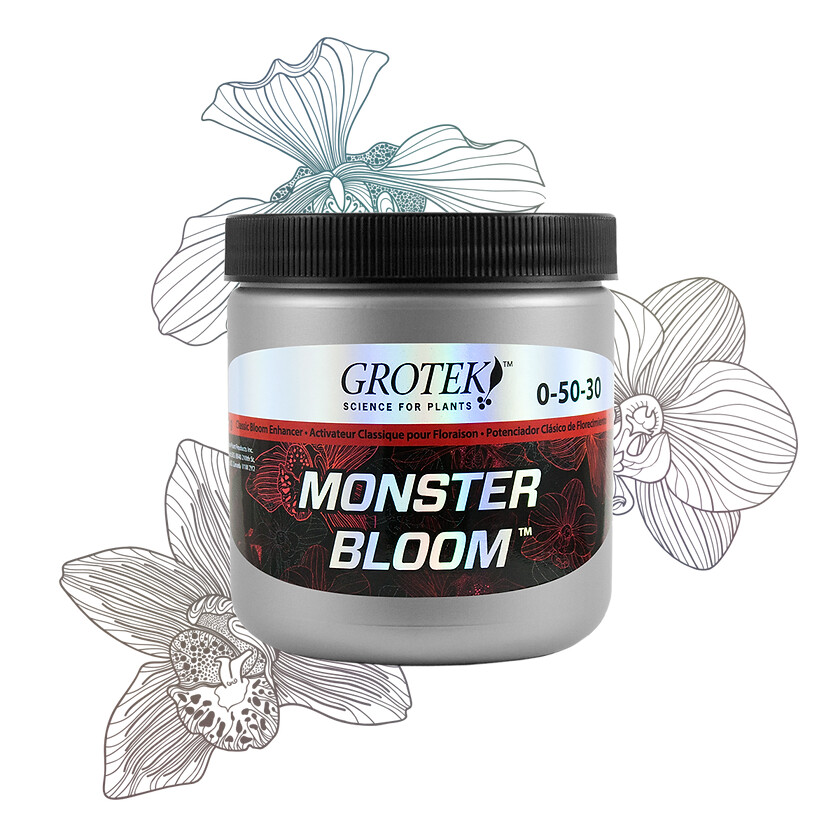
Fertilizer labels show three numbers in a fixed order: nitrogen, phosphorus, potassium (N-P-K). Monster Bloom is labelled 0-50-30. That means it contains no nitrogen, a lot of phosphorus and somewhat less potassium. CANNA PK 13/14 gives only the P and K figures: 13 and 14. On fertilizer labels, the phosphorus and potassium figures are normally given as P₂O₅ and K₂O, not as pure P and K. The 13/14 name comes from an older European way of stating the figures by volume. North American labels list the same product by weight as 0-10-11. When you compare products, use the label for your region.
Example products
These are named only as examples, not as recommendations. Other brands make products that do the same job.
- Monster Bloom (Grotek) — 0-50-30
- CANNA PK 13/14
- Overdrive (Advanced Nutrients)
When to add it
The usual window is mid to late flowering, around weeks 3–6 of flowering. Buds put on most of their weight during this period. Supporting that weight is the reason for adding PK.
This window is not fixed. It depends on the strain and on how long it flowers. A strain that flowers for longer than average needs the window moved later. Check the breeder’s flowering time and count from the day flowering starts. For what happens in each week, see cannabis flowering stages.
Dose and risk
The original article gave no dose. Use the dose on the label or in the brand’s official feeding chart, and start at the low end. PK products are concentrated salts. Too much raises the salt level in the root zone and can burn the roots. The first visible sign is usually burnt leaf tips (see nutrient burn).
What to do: Measure the EC of your solution before and after adding the PK product. This shows how much the product adds to your total feed. Write both numbers in your grow log every time you mix.
What a stimulant does
A stimulant is a supplement. It does not feed the plant directly. Instead, it is meant to support three processes inside the plant:
- Cell division and metabolism. Metabolism is the set of chemical reactions the plant uses to grow.
- Nutrient uptake. It helps the plant absorb nutrients from the base feed.
- Stress tolerance. It helps the plant cope with heat, transplanting and similar stress.
Many of these products are sold as “biostimulants”. The claims above are general. Each product’s label states its actual ingredients and purpose.
Example products
These are also examples only, not recommendations.
- Vitamax Pro (Grotek) — a kelp-based stimulant
- Bud Fuel Pro (Grotek) — a supplement for pre-flowering and early flowering. Its US distributor lists it as discontinued.
- CANNA Boost Accelerator
When to use it
Depending on the type, stimulants are used at different points across the whole life cycle. Some are made for roots and early growth, and others for flowering. Read the label to see which stage a product is for.
Is it really “safer”?
The original version of this article said stimulants are safer than PK products. It gave no basis for that claim. Any concentrated product can harm plants if you overdose it, so follow the label dose.
How to tell whether it works for you
The effect of a stimulant is hard to see on a single plant. Run a small side-by-side trial instead. Take plants of the same strain from the same seed batch or mother plant, and give them identical conditions. Treat half with the stimulant and leave the other half without it. Record the dry weight and the number of days to harvest for each group.
What to do: Before buying a stimulant for a whole room, test it on four to six plants against an untreated group. You will learn whether it pays for itself in your conditions.
Side-by-side comparison
| PK product | Stimulant | |
|---|---|---|
| What it is | An additive to the base nutrient | A supplement that does not feed the plant directly |
| Main job | Supplies phosphorus and potassium | Supports cell division, nutrient uptake and stress tolerance |
| When | Flowering, mid to late (about weeks 3–6, adjusted for strain) | Throughout the life cycle, depending on product type |
| Risk of overuse | Can burn roots through salt build-up | Can also cause harm if overdosed; the “safer” claim is not supported |
| Can it replace the other? | No | No |
Using them together correctly
- Start with a complete base nutrient. Both additives sit on top of it.
- Use a stimulant before and during the cycle, according to its type. The purpose is to prepare the plant to take up nutrients and handle stress.
- Add a PK product during flowering. The purpose is to support flower weight and quality while the buds are filling out.
- Never use one in place of the other. A stimulant cannot supply missing phosphorus or potassium. A PK product cannot do the stimulant’s job.
- Add one new product at a time. If a problem appears, you will know which product caused it.
Conditions in Thailand and Southeast Asia
Translator’s note: At room or outdoor temperatures of 30–35 °C, plants transpire more and drink more water. The growing medium dries faster, and salts can build up between waterings. Measure the EC of the runoff (the water that drains out of the pot) once a week during flowering. If runoff EC keeps rising, reduce the PK dose before you see burnt tips.
Translator’s note: In the rainy season, high humidity slows transpiration, so plants use less water. The medium stays wet for longer. Do not raise additive doses to make up for slower growth. Check the climate first.
Translator’s note: Tap water and well water in many areas can be hard, meaning they carry calcium and magnesium. These minerals already add to your EC. Measure the EC of your plain water before mixing anything. This tells you how much room is left for base nutrients and additives.
Translator’s note: Thai fertilizer rules come from the Fertilizer Act B.E. 2518 (1975), amended by the Fertilizer Act (No. 2) B.E. 2550 (2007). Whether a stimulant or biostimulant counts as a fertilizer under this Act depends on what it contains. If you are unsure about a product, ask the Department of Agriculture (กรมวิชาการเกษตร). For how to check a product’s registration and label, see verifying a fertiliser is legally in Thailand.
Translator’s note: Not every product named above may be on sale in Thailand. To find a product, ask the brand’s official distributor in Thailand. You can also ask other growers in the General Nutrients section. Avoid unlabelled or repackaged bottles, because you cannot verify their contents or dose.
What to do on your next cycle
- Measure the EC and pH of your plain water. This tells you your starting point before any fertilizer goes in.
- Mark each bottle as base or additive. This shows you which products are optional.
- Find the brand’s official feeding chart and write down the doses for each week. You then follow the maker’s numbers instead of guessing.
- Set your PK window from your strain’s flowering time, not from a fixed week number. That way the PK goes in while the buds are filling out.
- Test any stimulant on a small group against an untreated group. You will know whether it is worth the cost in your room.
- Log the EC of the solution and runoff weekly during flowering. You will spot salt build-up before it burns roots.
If you have a question about your own feeding programme, post it below this topic. Include your base nutrient, the additives you use, your water EC and your room temperature. Other growers can then give you an answer that fits your setup.
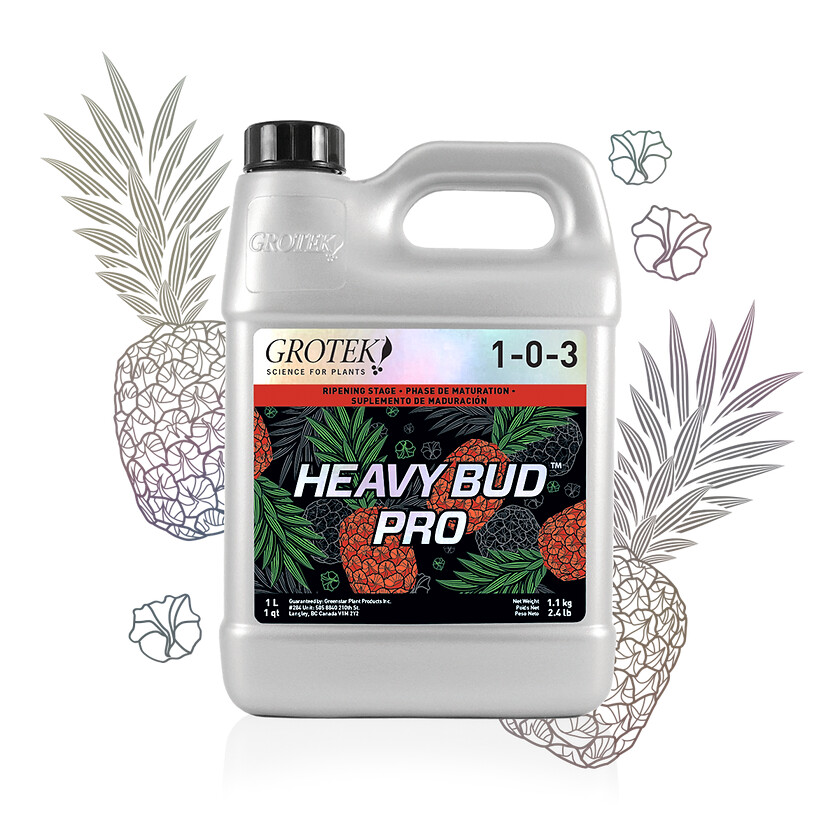
 MONSTER BLOOM & HEAVY BUD PRO – THE GOLDEN DUO FOR BLOOMING & FRUIT RIPENING
 MONSTER BLOOM – Specialized PK fertilizer
 NPK 0-50-30 – Rich in phosphorus & potassium
 Increases flower size and density
 Usage suggestion:
 The perfect combination for GACP farmers & professional indoor growers.
 Contact us to receive a detailed feeding schedule & free technical advice!