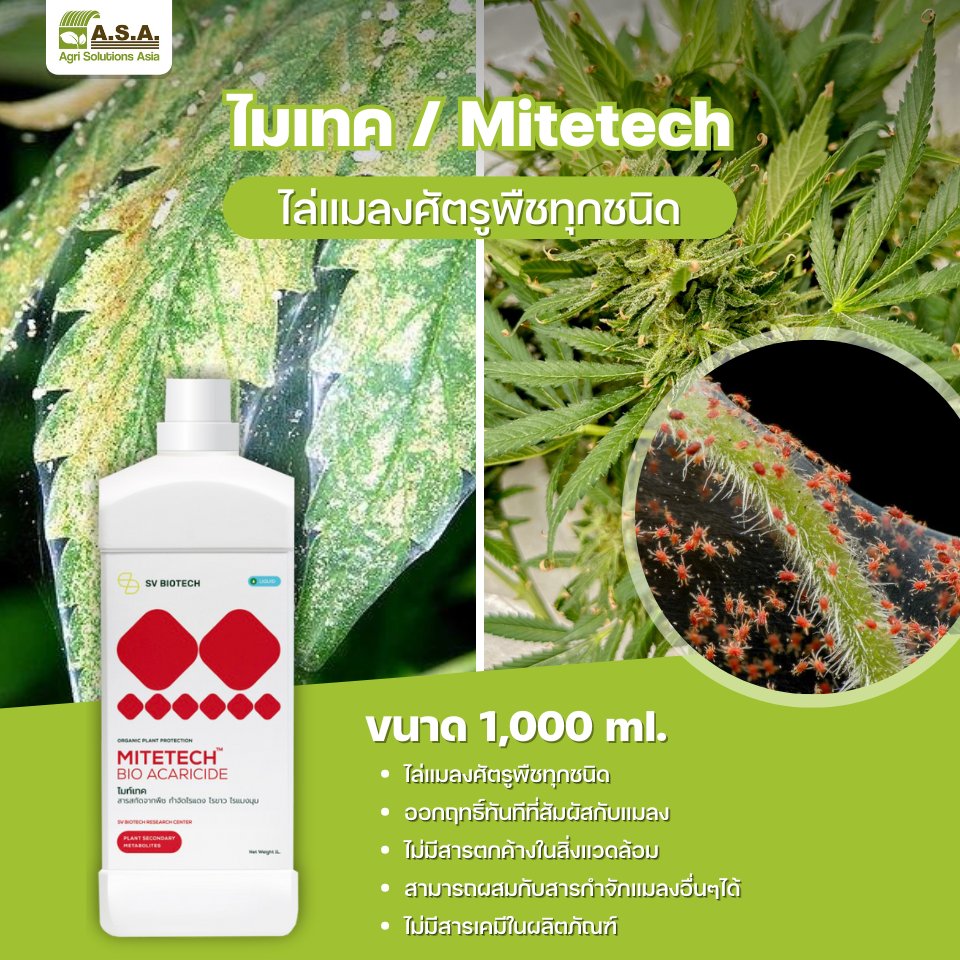
Image: product photo from the original forum post.
A plant-based mite product used by some growers in Southeast Asia: what the reviewer found, and what you still need to check
Some cannabis growers in Thailand, Laos and Vietnam use Mitetech Bio Acaricide instead of synthetic miticides (chemical mite killers). The synthetic products they replace include Abamectin, Fenpyroximate and Spiromesifen.
Growers give two reasons for the switch: lower toxicity and less leaf burn. Whether any residue stays in the flower is a separate question. Only a residue test on the harvested batch can answer it.
This review comes from a grower who used the product on real crops. The original post does not name the reviewer, the farm or the number of plants, and it gives no measured results. Read it as one grower’s experience, not as a trial.
1. What Mitetech is
Mitetech is an organic product made from plant secondary metabolites. These are compounds a plant makes for defence, not for growth, and they are extracted for use as the active ingredient.
The product targets four kinds of mites:
- Two-spotted spider mites (the common spider mite that spins webbing under leaves)
- White mites
- Broad mites (tiny mites that twist and blister new growth)
- Russet mites (mites too small to see without a magnifier)
According to the original post, the developer is SV Biotech. The reviewer says the product is fairly widely used on indoor and outdoor farms.
Translator’s note: “White mites” is a loose name. Growers use it for different small, pale mites, so ask what exactly the seller means. If you are not sure which mite you have, look at it under a loupe of 30× or more before choosing any product.
What to do: identify your mite under magnification first. Knowing the species tells you whether this product is even labelled for your problem.
2. How it kills mites
The reviewer describes it as working differently from chemical pesticides. According to the product information, it acts in three ways.
- Contact: it damages the fatty outer membrane of the mite. The mite loses water and can no longer hold on to the leaf, then dies within hours.
- Breathing: it blocks the spiracles, the small holes mites breathe through. The mite dies from lack of air.
- Breeding: eggs hatch poorly. The reviewer saw the population drop fast after 2–3 spray rounds.
Because it attacks the mite in several ways at once, the reviewer believes mites find it hard to become resistant. The reviewer sees this as its main advantage over chemical miticides.
Translator’s note: “Organic” or “plant-based” does not mean outside the law. In Thailand, a product sold to kill pests must be registered with the Department of Agriculture (กรมวิชาการเกษตร) and used as the label says. We could not confirm from public sources whether Mitetech Bio Acaricide holds a current Department of Agriculture registration, or for which crops and pests. Read our topic on what you may legally spray on cannabis before you buy.
What to do: ask the seller for the registration number and the Thai label. Keep a copy with your spray records, because an auditor may ask for it.
3. What the reviewer liked
- Low risk of leaf burn, in the reviewer’s experience. Still, avoid spraying flowers late in bloom.
- Plant-based active ingredient. If you supply the medical market, confirm residue levels with a lab test first.
- Steady results against spider mites and broad mites.
- Mixes with many other products, according to the reviewer. Check the product label for which tank mixes it allows.
- No strong smell, and it is easy to spray.
- No effect on terpenes or resin, according to the reviewer. The original gives no lab data for this.
Translator’s note: “Mixes with many products” and “no effect on terpenes” are the reviewer’s impressions, not measured results. Before you tank-mix with a fertiliser or another spray, test the mix on two or three plants and wait 2–3 days. This tells you whether the combination burns leaves in your conditions. In Thai heat of 30–35 °C, leaf burn from sprays is more likely than in cooler climates.
What to do: for medical or export flower, send a sample of the harvested batch for a pesticide residue test. This is the only way to know what is left in the flower.
4. Where it falls short
- It is weaker than chemical miticides when the infestation is heavy.
- You must spray more than once to kill every life stage. A single spray misses eggs that hatch later.
- It costs more than neem oil or mineral oil.
What to do: treat early. Check plants every few days so you catch mites while numbers are still low, when this kind of product works best.
5. How the reviewer used it
Mix at the rate on the product label. The original gives no dose of its own. The spray intervals below are the ones used in this review.
Light infestation
- Spray twice: Day 1 and Day 4.
Heavy infestation
- Spray on Day 1, Day 3 and Day 6.
- Cover the undersides of the leaves thoroughly. Spider mites live and lay eggs there.
The repeat sprays are spaced to hit mites that hatch from eggs after the first spray.
Tips from the reviewer, with the reason for each:
- Turn off the lights when you spray. Wet leaves under strong lights can scorch, and the spray dries before it has time to work.
- Increase airflow when you spray indoors. Leaves dry faster afterwards, which lowers the risk of mould.
- Use sticky traps alongside the spray. Traps let you see whether pest numbers are falling between sprays. Our topic on integrated pest management covers traps and scouting records.
- Rotate with neem oil, Beauveria or Spinosad (organic options). Changing the active ingredient slows resistance. Beauveria is a fungus that infects insects and mites. Spinosad is made from a soil bacterium.
Translator’s note: In the Thai rainy season, humidity often stays above 80%. Spray early in the day and keep fans running so leaves dry within a few hours. Beauveria is a living fungus, so check the label for storage temperature, as heat can kill it. Check that every product in your rotation is registered with the Department of Agriculture for your crop and pest. To buy, ask an authorized distributor in Thailand, or ask other growers in the Diseases, Insects and Mites section.
What to do: write each spray in a log, with the date, product, rate and how many mites you count on 10 marked leaves. After two weeks you will know whether the product is working on your farm.
6. Bottom line
Mitetech Bio Acaricide can be one option for light to moderate spider mite problems. It works only if you spray it repeatedly and rotate it with other active ingredients to slow resistance. Test the harvested flower for residues, especially if it is meant for the medical market.
What to do: start on a small group of plants, follow the spray schedule above, and count mites before and after. Expand only if the counts fall.
Have you used Mitetech? Post your results below: the mite species, how bad the infestation was, your spray schedule and what happened. Mite counts are the most useful thing you can share.