Most leaf problems that look like a nutrient deficiency are not caused by a missing nutrient. They come from root-zone pH outside the right range, from salt build-up, or from damaged roots. Check pH, runoff EC and roots first; then read where on the plant the symptom started, because that tells you which group of nutrients to suspect. This guide covers both halves: the diagnostic routine, and the leaf signs of each deficiency and excess.
1. Why Leaves Are Your Plant’s Dashboard
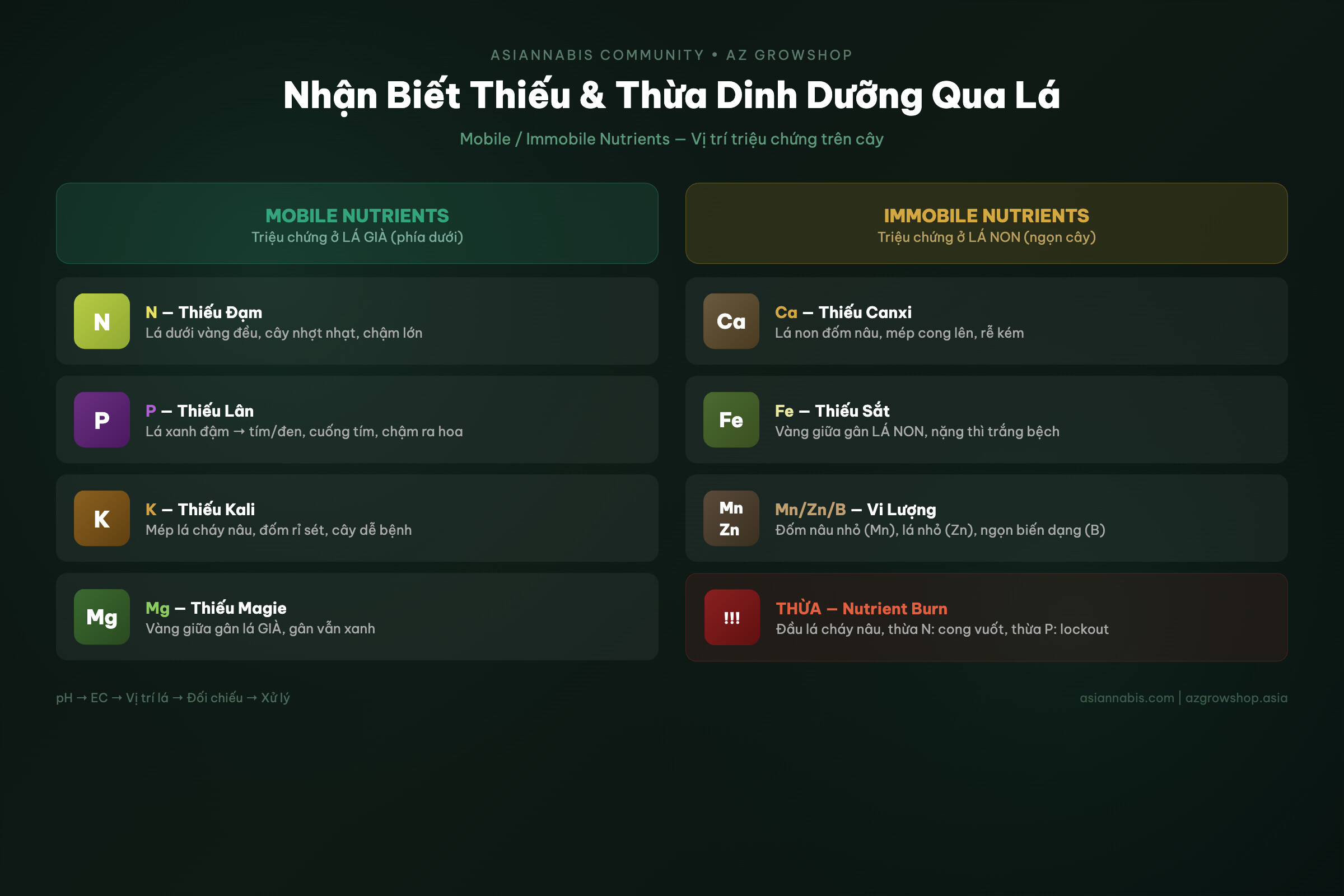
Cannabis leaves show nutritional status through colour, shape and — most usefully — the position of the affected leaves. The key principle is whether a nutrient is mobile inside the plant.
- Mobile nutrients — N, P, K, Mg (and Mo). When supply runs short, the plant moves them out of older leaves to feed new growth. Symptoms appear first on the lower, older leaves and move upward.
- Immobile nutrients — Ca, Fe, Mn, Zn, B, Cu. Once fixed in tissue they cannot be moved, so new growth is built short of them from the start. Symptoms appear first on new growth at the top. Sulfur is sometimes called semi-mobile, but in cannabis its symptoms also show on new growth.
Symptoms on all leaf ages at once point away from a single deficiency and towards overfeeding, root damage, a pH crash or light bleaching.
2. Before You Reach for a Bottle: pH, Roots and EC
A grower who sees yellow leaves and immediately adds fertiliser skips the checks that find the real cause fastest.
Step 1 — Root-zone pH. In soil, measure runoff pH after irrigation. In coco or hydro, measure both the feed going in and the runoff coming out. Targets: soil 6.0–7.0, coco 5.8–6.2, hydro 5.5–6.5. If pH is outside range, correcting it alone often clears the symptoms within about a week, with no change to the feed.
Step 2 — Root health. Waterlogged, airless or damaged roots cannot absorb nutrients at any concentration. Healthy roots are white to cream, firm and numerous. Brown, slimy or foul-smelling roots mean root rot or anaerobic conditions, which must be fixed before any nutrient change can help.
Step 3 — Runoff EC. Runoff EC well above feed EC (more than about 0.5 mS/cm) means salts are accumulating. Runoff above 3.0–4.0 mS/cm is consistent with salt toxicity, which mimics deficiency while being caused by the opposite — too much fertiliser salt.
Leaf symptoms appear
        |
        v
Measure pH and EC of runoff
        |
        +--- pH out of range?   -> correct pH, wait 5-7 days, reassess
        +--- Runoff EC > 3.0?   -> flush, wait, reassess
        +--- Roots brown/slimy? -> treat root rot first
        |
        v
Symptoms on OLD leaves first?  -> mobile nutrient: N, P, K, Mg
Symptoms on NEW growth first?  -> immobile nutrient: Ca, Fe, Mn, Zn, B, S
Symptoms on ALL leaves at once? -> overfeeding, root damage, pH crash, light bleaching
3. Nitrogen (N) — Mobile
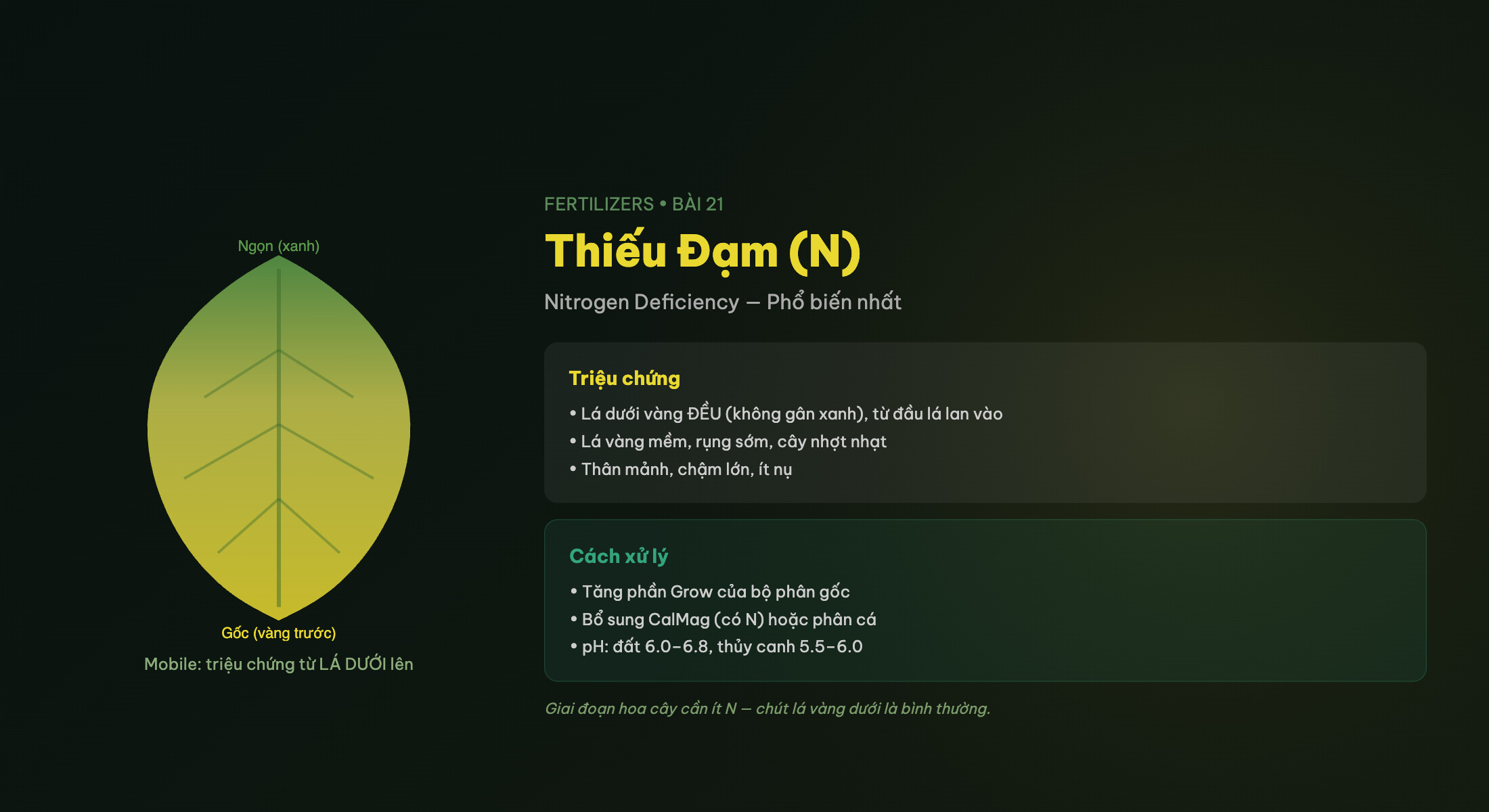
Nitrogen deficiency is the most common problem in cannabis, especially in veg, when the plant needs a lot of N for leaves and stems.
Symptoms
- Lower leaves turn uniformly pale, then yellow — the whole blade, with no green veins left — and then light brown before dropping
- Yellowing climbs the plant steadily from the bottom
- The plant looks washed out; stems are thin, growth slows, fewer bud sites form
The uniform yellowing, without a green-vein pattern, separates nitrogen deficiency from magnesium or iron deficiency.
Common causes: too little N in the feed, especially late in an organic mix’s life; pH outside range (nitrate and ammonium uptake is pH-sensitive); root damage from overwatering or compaction; excessive flushing.
Fix
- Raise the grow component of the base nutrients
- For a quick N source, a CalMag product containing calcium nitrate, or fish emulsion in organic systems
- Check pH first
In late flower some lower-leaf yellowing is normal: the plant remobilises nitrogen as it matures. Do not correct it.
4. Phosphorus (P) — Mobile
Phosphorus drives energy transfer, root development and flower formation.
Symptoms
- Older leaves first turn unusually dark green or blue-green rather than yellow
- Purple, red or maroon colour develops on petioles, stems and leaf undersides (anthocyanin build-up)
- Dark necrotic spots on old leaves in advanced stages; leaves may curl down
- Slow growth, weak roots, delayed flowering, small flowers and low resin
Common causes: pH below 5.5 or above 7.0 (phosphorus precipitates with calcium, iron or aluminium at the extremes); root zone below about 15°C, since P uptake depends strongly on temperature; excess iron or zinc competing for uptake.
Fix: correct pH, then raise bloom nutrients or add a PK product. Organic sources: bone meal, bat guano, rock phosphate.
Purple colour alone is not proof. Many cultivars produce anthocyanins genetically, especially in cool nights. Suspect phosphorus only if purple petioles come with stunted growth and pH and EC are otherwise in order.
5. Potassium (K) — Mobile
Potassium regulates water pressure in cells, stomata and sugar transport.
Symptoms
- Margins and tips of older leaves turn yellow, then brown and scorched; the centre stays green for a while
- Leaves become dry and brittle; rust-coloured spots may appear on the blade
- Margins may curl up before necrosis; plants are weaker against pests and disease
Common causes: pH below 5.5 or above 7.0; a feed high in ammonium, which competes with potassium for the same root transporters; sodium in the water displacing potassium from exchange sites.
Fix: correct pH, then raise bloom/PK feeding or add potassium silicate (which also strengthens stems). Organic: kelp meal, or wood ash — which raises pH, so use it carefully.
Burnt tips in late flower are often normal ageing plus high potassium demand, not a deficiency to correct.
6. Calcium and Magnesium (CalMag)
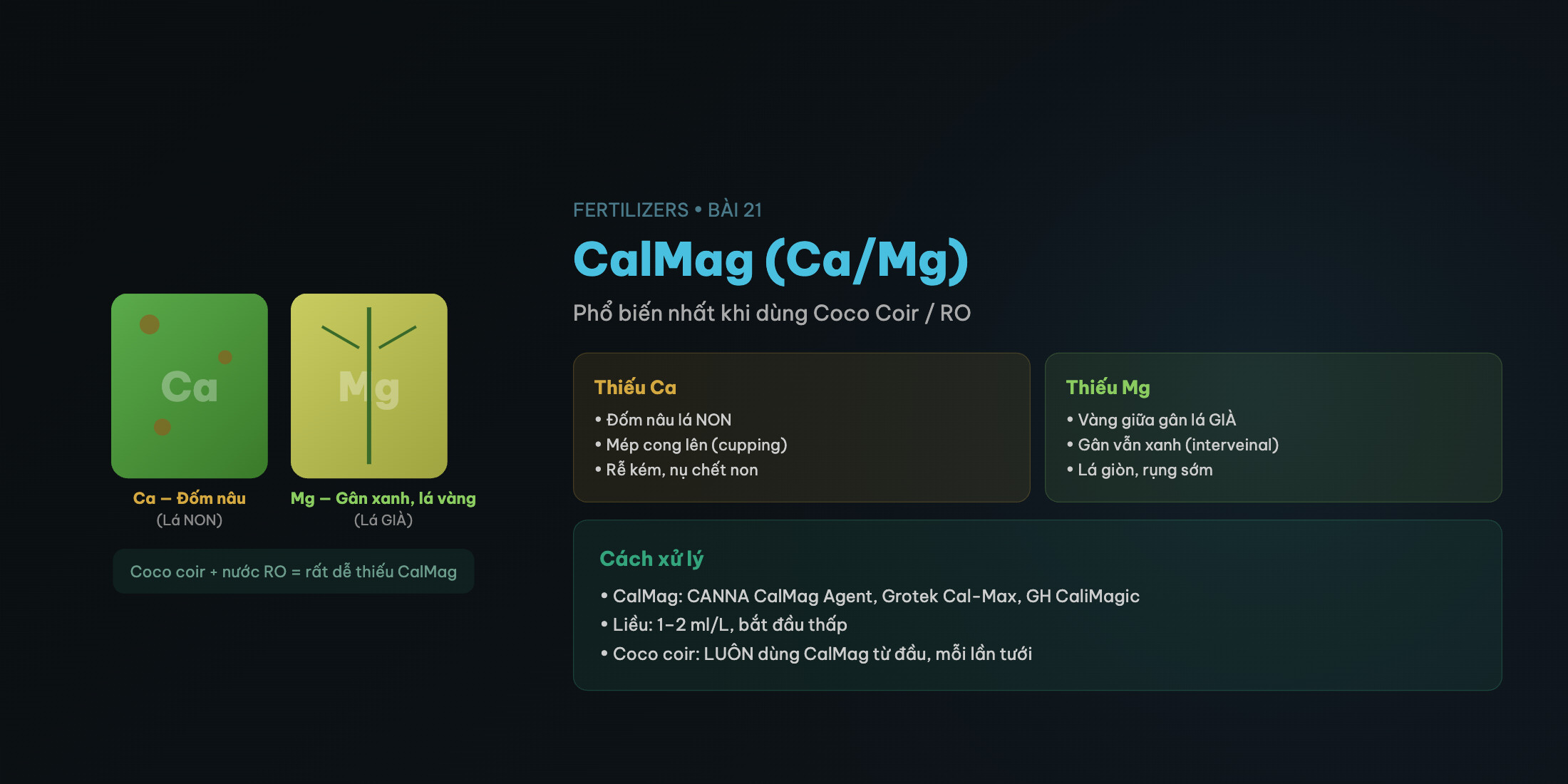
Calcium and magnesium deficiencies are very common in coco coir and with RO or filtered water.
Calcium (Ca) — immobile
Symptoms: brown or tan spots on new leaves, sometimes described as leopard spotting; new leaves cup, twist or fail to unfurl properly; weak root tips; in flower, buds may abort.
Common causes: pH below 5.5; unbuffered coco stripping calcium from the root zone; a feed with too much magnesium relative to calcium, since the two compete; and low transpiration. Calcium travels only in the transpiration stream, so very high humidity, low VPD or poor airflow can starve growing tips even when the root zone has enough. Tip burn under strong light and heat, when growth outruns calcium delivery, is fixed by improving VPD and airflow, not by adding calcium.
Magnesium (Mg) — mobile
Symptoms: interveinal chlorosis on older leaves — the tissue between the veins turns yellow while the veins stay distinctly green, a sharp fishbone pattern. Later the yellow areas turn tan with necrotic spots, leaves become brittle, curl and drop. It moves from the bottom up.
Common causes: pH below 6.0 in soil or below 5.5 in coco (the most frequent cause); heavy potassium feeding, since potassium and magnesium compete; RO or very soft water without CalMag; frequent coco irrigation with too little magnesium in the feed.
Fix
- Add a CalMag supplement at the label rate, starting low and increasing gradually
- In coco and with RO water, most growers include CalMag from the first feed
- Check the Ca:Mg balance of the base nutrient and the humidity and airflow in the room
7. Micronutrients: Iron, Zinc, Manganese, Boron — and Sulfur
Micronutrients are needed in tiny amounts, but a shortage does real damage. All of these show on new growth.
Iron (Fe). Interveinal yellowing on the newest leaves, veins green; in severe cases new leaves turn almost white. At the level of a single leaf it looks identical to magnesium deficiency — the position on the plant tells them apart. Causes: root-zone pH above about 6.5; bicarbonate-rich water slowly raising pH; high phosphorus forming insoluble iron phosphate; waterlogged roots.
Zinc (Zn). New leaves small, narrow, wavy or wrinkled; internodes abnormally short, giving a stunted, compressed look; some interveinal chlorosis on new growth. Causes: pH above 6.5–7.0; excess phosphorus.
Manganese (Mn). Interveinal chlorosis with small tan or brown spots on young to mid-age leaves. Easily confused with magnesium deficiency, but on newer tissue. Relatively uncommon under commercial feeding. Causes: pH above 6.5; excess iron.
Boron (B). Growing tips deform; new leaves are thick, brittle and refuse to open; tips die back; stems may turn hollow or corky. It is one of the most distinctive deficiencies because it changes shape rather than colour. Causes: pH outside 6.0–7.0; uneven watering, since boron moves with the transpiration stream.
Sulfur (S). New growth turns uniformly pale yellow-green, without the interveinal pattern of iron or magnesium. Uncommon with mineral feeds, because sulfate salts supply sulfur incidentally; seen mostly in organic systems relying on slow mineralisation, in cool soil or with immature compost.
Fix: check pH first — most micronutrient symptoms are pH lockout, not true absence. If pH is right and symptoms persist, supplement at a low rate: chelated iron (EDDHA-Fe holds up best at higher pH), or zinc sulfate for zinc.
8. Deficiency Reference Table
| Nutrient | Mobile? | Main symptom | Appears first on | Most common cause |
|---|---|---|---|---|
| Nitrogen (N) | Yes | Uniform yellowing, bottom up | Oldest leaves | Too little N; pH out of range |
| Phosphorus (P) | Yes | Dark green, then purple petioles and undersides | Older leaves | pH <5.5 or >7.0; cold root zone |
| Potassium (K) | Yes | Brown, scorched margins and tips | Oldest leaves | pH imbalance; high ammonium or sodium |
| Magnesium (Mg) | Yes | Interveinal chlorosis, green veins | Older leaves | pH <6.0 in soil; high K feed; soft water |
| Calcium (Ca) | No | Brown spots; distorted new leaves | Newest leaves | pH <5.5; low transpiration; unbuffered coco |
| Iron (Fe) | No | Interveinal chlorosis | Newest leaves | pH >6.5; bicarbonate; waterlogging |
| Zinc (Zn) | No | Small, distorted leaves; short internodes | New growth | pH >7.0; excess phosphorus |
| Manganese (Mn) | No | Interveinal chlorosis with necrotic spots | Young to mid leaves | pH >6.5; excess iron |
| Boron (B) | No | Thick, brittle, deformed new growth | Growing tips | pH out of range; uneven watering |
| Sulfur (S) | Partly | Uniform yellowing of new growth | Youngest growth | Organic systems, slow mineralisation |
9. Too Much: Nutrient Burn and Toxicity
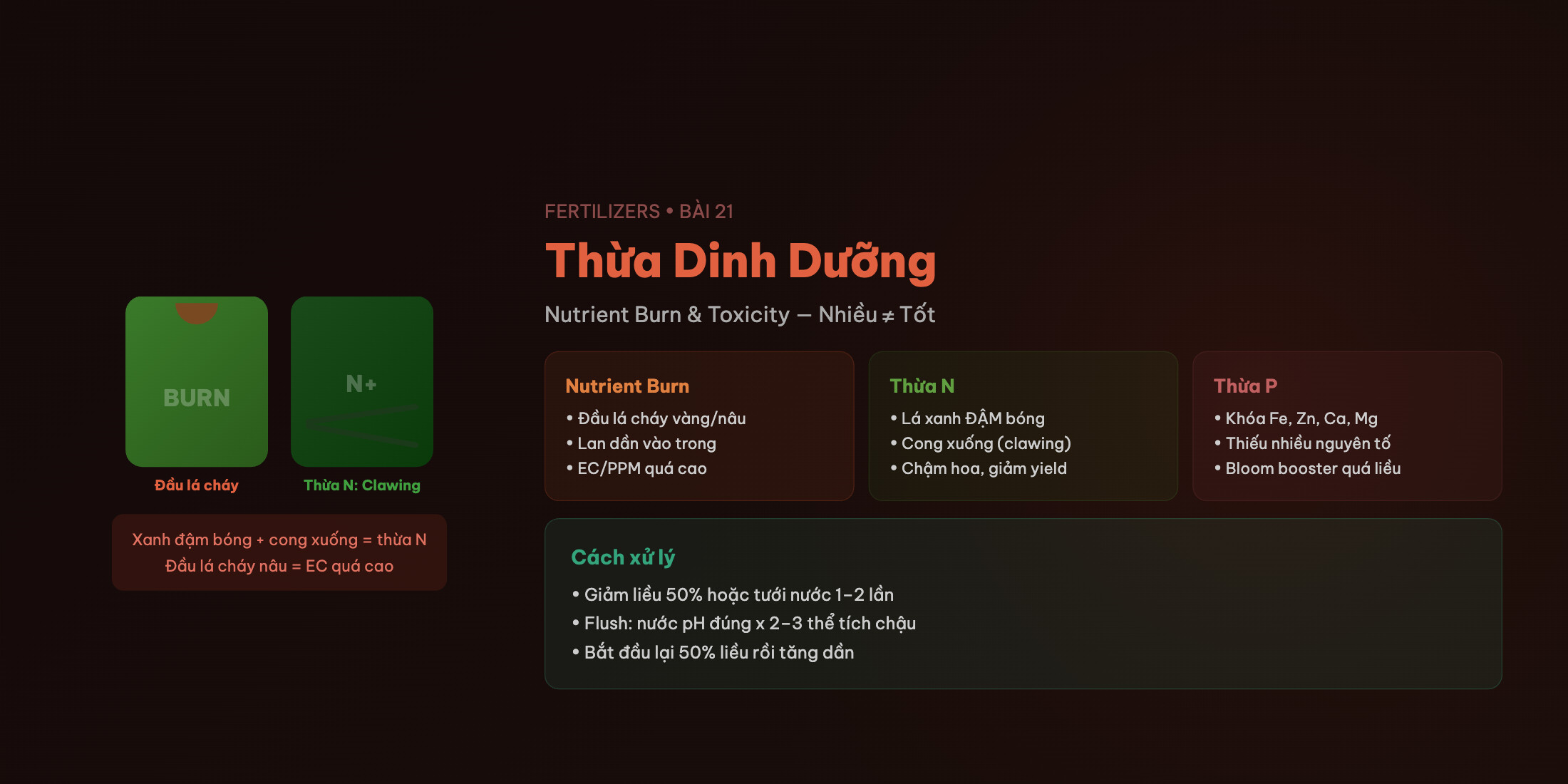
Too much is as harmful as too little. Many beginners overfeed on the idea that more is better.
Nutrient burn. Leaf tips turn yellow, then brown and crispy, starting at the very points and moving inward if nothing changes. Cause: feed EC or PPM too high.
Nitrogen toxicity. Leaves unusually dark green and glossy, curling down like claws — the most distinctive sign. Flowering is delayed, buds airy, yield lower.
Phosphorus toxicity. Excess phosphorus locks out iron, zinc, calcium and magnesium, so several deficiency symptoms appear at once. The usual cause is too much bloom booster.
Fix
- Cut feeding immediately: half strength, or plain water for one or two irrigations
- Light flush with correctly pH-adjusted water at 2–3 times the pot volume
- Restart at half the recommended rate and build up gradually
Overfeeding or deficiency?
| Deficiency | Overfeeding / salt toxicity | |
|---|---|---|
| Leaf margins | Yellowing or spotting, not crispy | Crispy, dark brown tips and margins |
| Pattern | Follows mobile/immobile logic | Tips and margins on many leaf ages |
| Runoff EC | Normal or low (<2.0 mS/cm) | High (>3.0–4.0 mS/cm) |
| Leaf feel | Soft, papery | Dry and brittle where affected |
| Vigour | Slow growth | Often vigorous until toxicity is advanced |
| Response to more feed | May improve | Gets worse |
| Response to a flush | Little direct effect | Usually improves within 3–7 days |
When runoff EC is above 3.0–4.0 mS/cm, treat it as salt toxicity whatever the leaves seem to say.
10. Nutrient Lockout: Present but Not Available
Lockout means the nutrients are in the root zone but the plant cannot take them up.
- Cause 1: pH too high or too low
- Cause 2: EC too high — salt build-up around the roots blocks uptake
- Cause 3: one element in excess blocking another (excess P blocks Fe and Zn; excess K blocks Mg; excess Mg blocks Ca)
A typical costly sequence:
- The grower sees interveinal chlorosis on new leaves — an iron-deficiency picture
- Adds an iron chelate
- Root-zone pH in coco is actually 6.8, above the 5.8–6.2 target
- Iron stays unavailable; nothing improves
- The grower adds more iron, then CalMag, then blames the nutrient brand
- pH was the problem all along — correcting it at step 1 would have solved it
Adding more of a nutrient at the wrong pH does nothing for the plant and raises EC, stressing already weak roots further.
11. When to Flush and When to Feed
Flush — irrigate with pH-adjusted water at 0.2–0.5 EC to runoff, repeating until runoff EC falls towards feed EC — when:
- runoff EC is consistently well above feed EC (more than about 0.5–1.0 mS/cm), or above 3.0–3.5 mS/cm in any substrate;
- several deficiency symptoms appear at once without fitting a single mobile or immobile pattern — a strong sign of salt toxicity in disguise;
- you know an overfeeding event happened (wrong mixing ratio, wrong product).
After a flush, measure runoff pH and EC again; if runoff EC is still above 3.0, flush again before resuming at a low rate.
Feed — give targeted nutrition — when runoff EC is at or below target, pH is confirmed in range, and one specific symptom follows the expected mobile or immobile pattern.
12. The Five-Step Diagnostic Routine
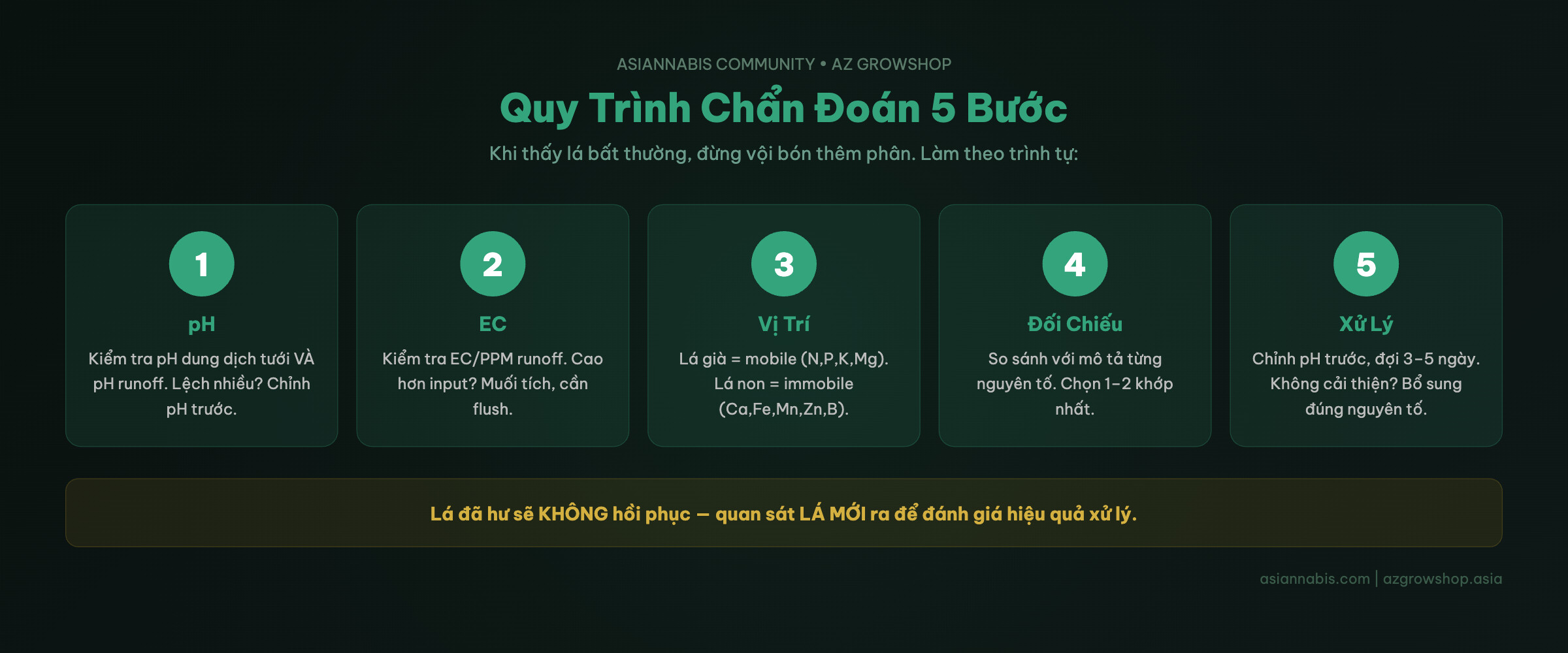
When leaves look wrong, do not rush to add nutrients. Work through this sequence:
- pH: measure the feed and the runoff.
- EC: measure runoff EC or PPM.
- Location: old leaves at the bottom = mobile nutrients (N, P, K, Mg); new leaves at the top = immobile nutrients (Ca, Fe, Mn, Zn, B).
- Compare: match the symptoms to the descriptions above and pick the one or two best fits.
- Treat: correct pH first and wait about 5–7 days. Only if there is no improvement, supplement the suspected element at a low rate.
Damaged leaves will not recover — judge any treatment by the new growth. A pH meter and an EC meter are the two most important diagnostic tools in the grow room; decisions made without them are guesses.
Legal Note
This article is for educational purposes only. Cannabis cultivation must comply with the law where you live. In Thailand, cannabis flower is a controlled herb under the Notification of the Ministry of Public Health Re: Controlled Herbs (Cannabis), B.E. 2568, and cultivation requires a licence under the rules that followed, including the Ministerial Regulation on Controlled Herbs (No. 2) B.E. 2569.
References
- Weedmaps Editors (updated 2026). “Nutrient deficiencies in cannabis: How to spot and address them.”
- Leafly (2025). “Cannabis nutrient deficiencies & leaf symptoms.”
- Sensi Seeds (2021). “How to Spot the 7 Most Common Cannabis Plant Deficiencies by Leaf Symptoms.”
- Organitek (2025). “11 Common Cannabis Nutrient Deficiencies.”
- Hey Abby (2025). “Cannabis Calcium & Magnesium Deficiency.”
- La Huerta Grow Shop. “How to Identify and Fix Nutrient Toxicity in Cannabis Plants.”