Gro-Silic is a supplement made by Grotek, a fertiliser company from Canada. It adds silicon (chemical symbol Si) to the water you give your plants. Growers often call it “silica”, which is the mineral form of silicon. The original post says many growing systems lack silicon. It also says cannabis uses silicon to build strong stems, resist pests and diseases, and cope with stress from heat, drought and strong light.
Translator’s note: The original post called silicon a “vital micronutrient”. That is not accurate. Silicon is not one of the essential plant nutrients, which are the elements a plant needs to finish its life cycle. Plant scientists class silicon as a “beneficial element”: plants can grow without it, but some crops do better with it. Read topic 1453 linked above to see which silicon claims hold up for cannabis.
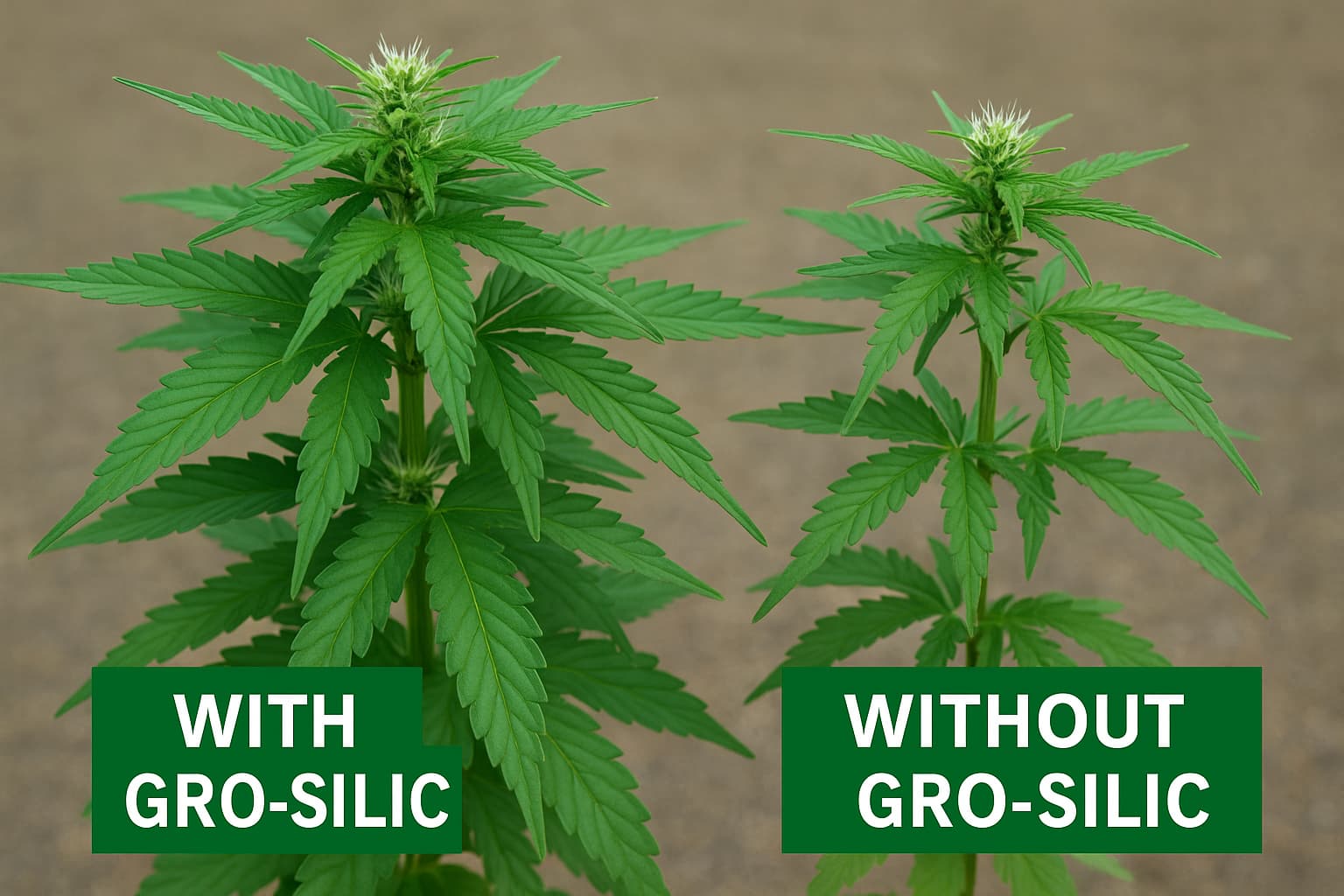
Image: Gro-Silic container, from the original version of this topic.
What the original post says Gro-Silic does
The original post lists five benefits:
- Stronger cell walls. A cell wall is the stiff outer layer around each plant cell. According to the post, stronger walls make stems sturdier, so they break less easily.
- More natural resistance to diseases and pests.
- Better photosynthesis and nutrient uptake. Photosynthesis is how leaves turn light into sugar for growth. Nutrient uptake is how well the roots absorb fertiliser.
- Better tolerance of high temperature, drought and intense light. These are types of abiotic stress, meaning stress that comes from the environment and not from pests or disease.
- Thicker, shinier leaves. The post links these leaves to heavier, more resinous flowers later in the crop.
The original gives no trial figures and no mechanism for any of these claims. Read them as the product’s own description, not as measured results. Before you count on any of them, run the small test described in the last section of this article.
Translator’s note: Gro-Silic is sold as a nutrient supplement, not as a pesticide. Do not use it in place of pest or disease control. In Thailand, use only pesticides registered with the Department of Agriculture (กรมวิชาการเกษตร), and use them as the label says. To build a pest plan, start with integrated pest management.
Start with the label on your own container
Use the dose printed on the container you actually have. Silicon supplements are sold at different strengths. A rate taken from another product does not apply to Gro-Silic. A rate from an older or newer Gro-Silic label may not apply either.
Before your first mix, copy the label rate into your feeding notes. That way everyone who mixes the tank uses the same number.
Mixing order: silicate first, pH last
Silicate supplements are alkaline, which means they raise the pH of your water. pH is the scale that shows how acidic or alkaline a solution is. Roots take up nutrients well only within a certain pH range, so a big rise in pH can affect feeding.
The original post quotes Grotek’s own instructions for Pro-Silicate, another silicate product from Grotek. Those instructions say Pro-Silicate is a strong base (a strongly alkaline chemical). They say it must never be added to nutrient concentrate, meaning fertiliser straight from the bottle before you dilute it. The original post applies the same handling to Gro-Silic. The Gro-Silic label carries the same warning: Gro-Silic is a strong base and should never be added to nutrient concentrates.
Mix in this order:
- Fill the tank with plain water. Measure its pH so you know your starting point.
- Pre-dilute your Gro-Silic dose in a separate jug of plain water. This way the concentrated silicate never touches an acidic product.
- Pour the diluted silicate into the tank and stir.
- Add your nutrients one product at a time, as their labels say.
- Measure pH again and adjust it last. The silicate and the nutrients both change pH, so any reading taken before this step will be wrong.
The original post also says: do not mix Gro-Silic with low-pH (acidic) products, mix it separately, and adjust pH last. This matches the steps above. “Separately” means Gro-Silic never goes into a bottle, cup or jug that holds nutrient concentrate or pH-down. It does not mean you need a separate tank. Rinse your measuring cup between products so no concentrate is left in it.
The original does not say what happens if you skip these steps. The Gro-Silic label says this order is meant to avoid precipitation of nutrients, meaning nutrients turn into solid particles in the tank instead of staying dissolved. Grotek’s Pro-Silicate instructions also warn that precipitates can form if the pH swings too much.
Write the five steps on a card and stick it beside your mixing tank. Anyone who mixes will then follow the same order.
Root drench
A root drench means watering the mixed solution into the growing medium so the roots can take it up.
- Dose: the rate on your container.
- How often: the original post suggests 1–2 times per week. The label gives no drench frequency.
- When in the crop (original post): from the vegetative stage, the growth phase before flowering, until week 3 of the flowering stage.
The original does not say why the drench stops at week 3 of flowering, and the label gives no such window. Treat it as a suggestion, not a rule, and follow your own label. Write the start and stop dates you choose in your feeding notes.
Foliar spray
A foliar spray means spraying a diluted product onto the leaves.
- How often: the original post suggests once per week (the label says once a month, see below).
- When in the crop: only in the vegetative stage. Do not spray during flowering.
- Time of day: early morning or late afternoon. Do not spray in direct sunlight.
The original gives no dilution rate for spraying. Do not work out a spray rate from the drench rate. Use the foliar rate on your label. The Gro-Silic label says to dilute to 1:500 or greater, apply at the 3–8 leaf stage, and then spray once a month as needed. That is less often than the weekly spray in the original post, so follow the label on your own container. If your label gives no foliar rate, ask the official distributor before you spray.
Mix the spray in the same order as the tank: plain water first, then the pre-diluted silicate, then a final pH check.
Translator’s note: In Thailand, afternoon temperatures often reach 30–35 °C, both outdoors and in greenhouses. In the hot season, early morning is usually the cooler time to spray. In the rainy season, humid air keeps leaves wet for longer. A late-afternoon spray can stay wet into the night, and leaves that stay wet for hours are more likely to get fungal disease. So in the rainy season, spray in the early morning so the leaves dry by midday.
Translator’s note: The original does not explain why spraying stops at flowering. In Thai conditions there are two practical reasons. First, wet flowers in humid weather raise the risk of bud rot. Second, anything sprayed on flowers can stay on the harvested product. After each spray, check that the leaves are dry within a few hours. If they are still wet at noon, spray less liquid or spray earlier.
Translator’s note: water and heat in Thailand
The pH of tap water and well water can vary a lot between places in Thailand and Southeast Asia. If your water already has a high pH, the silicate will push it higher, and you will need more pH-down. Measure the pH of your plain water once a week. This shows you how much of the change comes from your water and how much comes from the silicate. Topic 1403 explains why you should measure your own irrigation water.
The heat-tolerance claim matters in Thai grow rooms at 30–35 °C. Still, no supplement replaces cooling or airflow. First bring the room temperature under control with proper climate control. Then judge whether silicon adds anything.
Who the original post says it is for
- Medical cannabis grown to the GACP standard (Good Agricultural and Collection Practice, the quality standard for growing and harvesting medicinal plants).
- High-value crops such as fruit, ornamental plants and organic vegetables.
- All growing systems: outdoor, greenhouse, hydroponics (growing with roots in a nutrient solution or an inert medium) and automated setups.
Translator’s note: If you grow to GACP, write every input into your farm records. Record the product, batch number, rate, date and which plants were treated. Written records of inputs are part of GACP. They also let you trace a problem back to its cause.
Translator’s note: Before you use Gro-Silic on a crop sold as organic, ask your organic certifier whether they accept it. Tell them that, according to the label, the silicon in Gro-Silic comes from sodium silicate.
Translator’s note: In an automated dosing system, the same mixing rule applies. Set the silicate to dose into plain water first, and never into a line or mixing chamber that carries nutrient concentrate. The product page gives no separate instructions for injectors or dosing systems, so check your dosing system’s manual as well.
Buying it and checking that it is legal
Translator’s note: To buy Gro-Silic, ask the official distributor in Thailand. You can also ask other growers about their experience in the General Nutrients Q&A section of this forum.
In Thailand, fertilisers are covered by the Fertilizer Act B.E. 2518 (1975), as amended by the Fertilizer Act (No. 2) B.E. 2550 (2007). Before you buy, check the container using the steps in how to verify a fertiliser is legally on sale in Thailand. This confirms that the bottle in your hand is the product its label describes.
Try it on a small batch first
What you may get: according to the original post, sturdier stems, fewer pest and disease problems and better tolerance of stress. None of these is guaranteed.
How to apply it in Thailand: test it for one full crop cycle in your own heat, humidity and water.
Where to start:
- Choose plants of the same strain and age, growing in the same room. For example, use 4 treated plants and 4 untreated plants.
- Give Gro-Silic to one group at the label rate. Give the other group none. Keep everything else the same.
- Every week, record broken or bent stems, signs of pests or disease, and leaf condition. At harvest, record the dry yield of each group.
- Log the tank pH before and after adding the silicate. This tells you how much extra pH-down the product costs you.
After one cycle, compare the two groups. The results will tell you whether Gro-Silic is worth its cost in your conditions.
Questions and results
Have you used Gro-Silic or another silicon supplement in Thai heat? Post your label rate, your mixing order and what you saw below this topic. Questions about mixing or pH are welcome there too.
References
- Grotek. Pro-Silicate product page and directions. https://www.hydrofarm.com/p/grotek-pro-silicate/gtpros1l
- Grotek. Gro-Silic product page and label directions. https://www.hydrofarm.com/p/grotek-gro-silic/gtgs1l