Monster Bloom is a water-soluble powdered bloom booster from Grotek that supplies phosphorus and potassium only, with no nitrogen, for the flowering stage. It is meant to be added to a complete base nutrient, not to replace one. This article covers what the label says, what phosphorus and potassium do during flowering, how the manufacturer says to use it, and the mistakes growers most often make with a product like this.
What Is on the Label
Grotek’s product page gives this guaranteed analysis:
| Nutrient | Guaranteed analysis |
|---|---|
| Total nitrogen (N) | not listed |
| Available phosphoric acid (P₂O₅) | 50% |
| Soluble potash (K₂O) | 30% |
With no nitrogen listed, that is an NPK ratio of 0-50-30. The label lists one source material, monopotassium phosphate (MKP), which is why the powder dissolves readily in water.
Fertilizer labels state phosphorus and potassium as oxides (P₂O₅ and K₂O), not as the elements. Converted with the standard factors (P = P₂O₅ × 0.436, K = K₂O × 0.830), 50% P₂O₅ is about 21.8% elemental phosphorus and 30% K₂O is about 24.9% elemental potassium. This matters when you compare it with a product labelled in elemental form.
What Phosphorus and Potassium Do in Flowering
- Phosphorus is part of ATP, the molecule plants use to move energy, and of DNA and cell membranes. Demand rises when the plant is building new flower tissue.
- Potassium regulates water movement and the opening of stomata, activates many enzymes, and moves sugars and starches from the leaves to the flowers.
Grotek describes the product as supporting protein and starch synthesis, stalk and stem strength, the movement of sugars and starches within the plant, and respiration and CO₂ uptake during bud development.
A PK booster only works on top of a complete feed. Nitrogen, calcium, magnesium, sulfur and the micronutrients still have to come from the base nutrient.
How to Use It
The manufacturer’s directions:
- Mixing rate: 1 teaspoon per 5 US gallons of water (6 g per 19 L), for soil, soilless and water culture
- When to start: when buds are forming
- How often: with every fertilizer application during the flowering cycle
- When to stop: 1-2 weeks before harvest
Grotek lists it as compatible with hydroponics and soilless media (peat and coco). Always check the EC and pH of the final solution after adding it. For what the research says about the final weeks before harvest, see Pre-Harvest Flushing: Science or Myth?.
Common Mistakes
- Overdosing: more phosphorus and potassium than the plant can use raises the EC of the root zone and can cause salt stress and burnt leaf tips. Excess phosphorus can also interfere with the uptake of micronutrients such as zinc and iron.
- Starting too early: in the first weeks of flowering the plant is still stretching and needs nitrogen. A booster with no nitrogen belongs to the bud-building phase.
- Stacking boosters: using two PK products at the same time doubles the phosphorus and potassium without anyone noticing. Read the labels of everything in the tank.
- Treating it as a complete feed: it contains no nitrogen, calcium or magnesium.
- Skipping pH checks: monopotassium phosphate solutions are mildly acidic, so the pH of the tank can shift after you add it.
Sizes
Grotek lists Monster Bloom in 130 g, 500 g, 2.5 kg, 5 kg and 10 kg packs. Grotek is a Hydrofarm brand.
Buying Monster Bloom from AZ Growshop
We are AZ Growshop, an authorized Grotek distributor for Thailand. We supply Monster Bloom in the manufacturer’s original sealed packaging, together with the product documentation, including the certificate of analysis (COA) and safety data sheet (SDS), and technical support for growers working toward GACP standards.
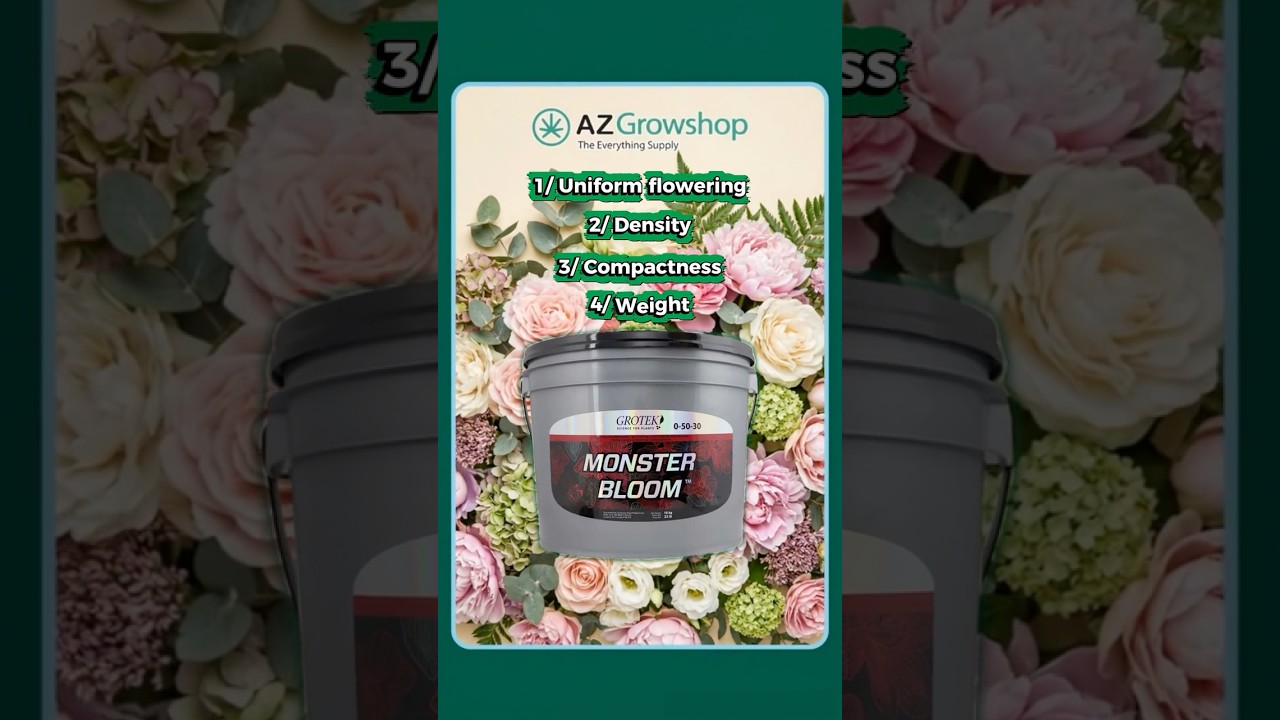
Our video on Monster Bloom:
Contact us to order or to discuss a feeding programme.